
AI isn’t just a technology risk anymore — it’s a liability risk.
Organizations are rolling out chatbots, copilots, recommendation engines, and fraud models faster than their governance, legal, and security controls can keep up. And that’s how you accidentally drift from “innovative” to “liable.”
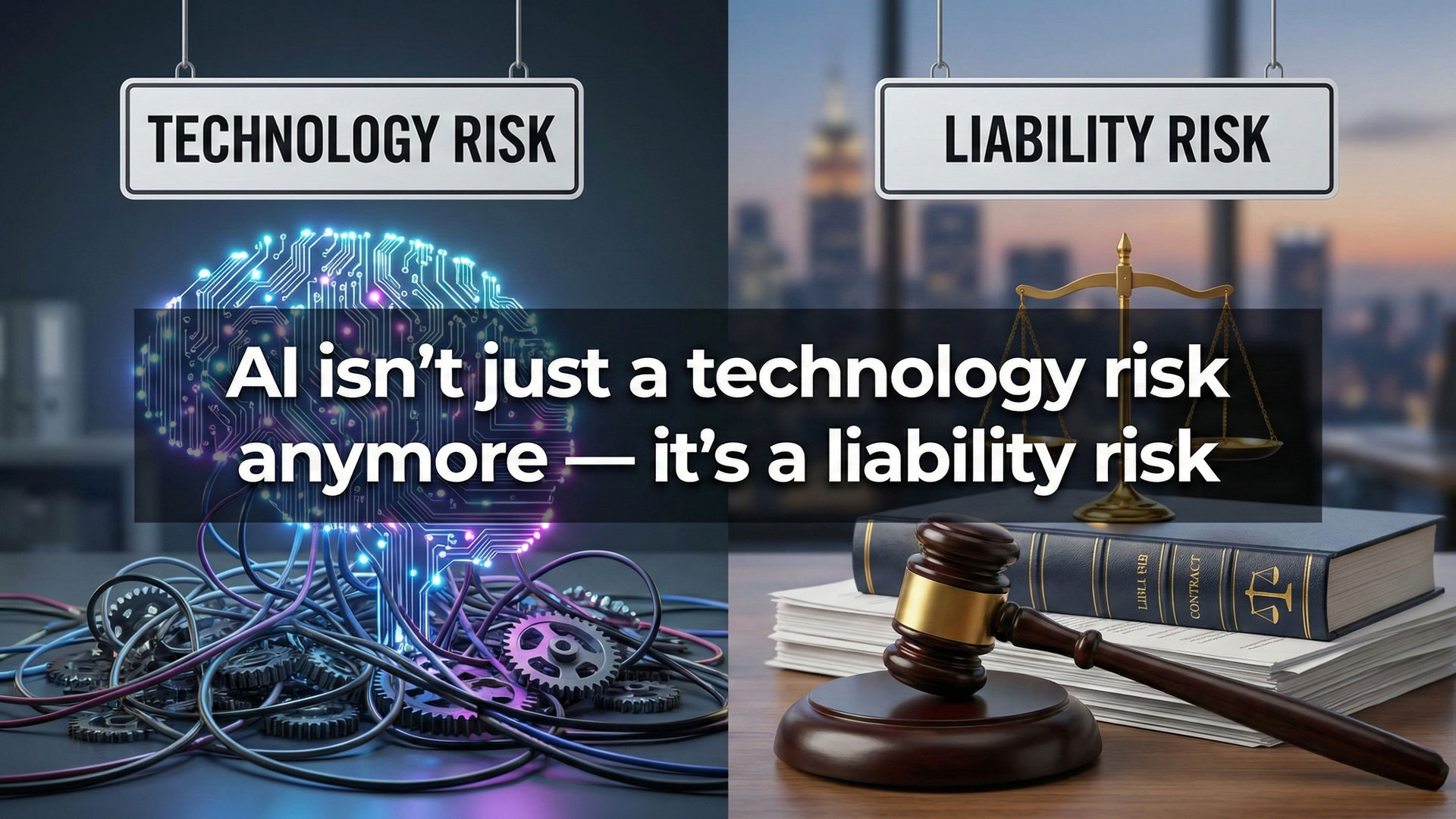
Here are five ways AI quietly creates legal exposure — and what to do about each.
1) Privacy & data protection: training your way into a complaint
AI loves data. The problem is that “useful” data is often personal data: support tickets, HR notes, emails, medical info, location data, biometrics, “anonymized” datasets that aren’t really anonymous, etc.
European regulators have been explicit that AI models trained on personal data can’t automatically be treated as anonymous—especially where model extraction or “regurgitation” is plausible.
You move into risk when you:
- Fine-tune on production logs that still contain names, emails, IDs, or full chat histories.
- Use web-scraped datasets without validating the original collection rights and notices.
- Let staff paste confidential info into public AI tools without understanding retention and reuse.
Do this instead: data classification + “AI-approved data” rules, minimization, retention limits, and red-teaming for sensitive data leakage.
2) Intellectual property: when “training data” becomes evidence
Generative AI can reproduce copyrighted-style material (text, code, images) in ways that create real disputes. The U.S. Copyright Office has also reiterated that copyright protection requires human authorship, and AI-generated material is treated differently in registration and protection.
You increase risk when:
- Your corpus includes copyrighted content scraped without licenses or a defensible legal theory.
- Internal users rely on outputs that are substantially similar to existing logos, brand assets, code, or documents.
- Teams use AI to “recreate” competitor materials (even if nobody says that part out loud).
Do this instead: enforce provenance controls (licensed sources), output review gates for high-visibility assets, and clear “no competitor reconstruction” rules.
3) Discrimination & bias: automated decisions still trigger human-law consequences
If AI touches hiring, promotions, lending, insurance, tenant screening, or healthcare, you’re on sensitive legal ground. Regulators have warned that automated systems can still violate anti-discrimination and consumer protection laws—and enforcement applies to both developers and deployers.
Common failure modes:
- Training on historical decisions that already embed unfair patterns.
- Using proxy variables (postal/ZIP code, school, device type) that correlate with protected characteristics.
- Shipping “black box” outcomes without meaningful explanations, monitoring, and appeal paths.
Do this instead: bias testing before launch, continuous monitoring, documentation, and human review for high-impact decisions.
4) Defamation & false content: “hallucinations” don’t get a legal pass
AI can confidently generate false claims about real people and organizations. If your chatbot publishes or amplifies harmful inaccuracies, “the model did it” won’t protect you.
On top of that, rules are tightening. The EU AI Act uses a risk-based approach with transparency and governance obligations in multiple AI use cases.
You create exposure when:
- Customer-facing AI answers without source grounding or escalation paths.
- Internal assistants generate unverified “facts” about employees, vendors, or competitors.
- Marketing uses AI claims that aren’t provably true (especially in regulated industries).
Do this instead: require citations/sources for factual claims, add “uncertainty handling,” and implement hard escalation triggers.
5) Regulatory non-compliance: AI doesn’t replace controls — it increases expectations
In finance, healthcare, transportation, energy, and critical infrastructure, sector rules don’t disappear because the decision is “AI-assisted.” Regulators increasingly expect explainability, audit trails, and accountable governance.
The EU AI Act explicitly sets obligations for high-risk AI systems, including documentation, oversight, and risk management expectations.
You create compliance headaches when:
- AI changes high-impact decision workflows but policies/controls remain outdated.
- You can’t reproduce how the model reached a decision (no logs, no model governance).
- You buy third-party AI “black boxes” without contractual responsibility, transparency, or audit rights.
Do this instead: treat AI like a regulated system: documented lifecycle, change control, vendor due diligence, and auditability.
The practical fix: train the people who own the risk
Most AI failures aren’t model failures — they’re governance failures.
That’s exactly why Mile2’s Certified AI Cybersecurity Officer (C)AICSO™ exists: it’s designed for leaders who need to govern, defend, and audit AI responsibly, not just “use AI tools.” It explicitly covers:
- Governance, legal/regulatory, and security-by-design
- AI threat landscape and adversarial use case mapping (including MITRE ATLAS and the OWASP LLM Top 10)
- Auditing/testing AI systems, AI-centric incident response, and data governance updates
It’s a 5-day course (40 CEUs) with an exam that’s ~2 hours / 100 questions.
If your organization is deploying AI in production (or even planning to), this cert is the fastest way to stop improvising governance and start running AI like a real risk program.
Do this this week (no overthinking)
- Inventory where AI is used (even “shadow AI” in departments).
- Classify which use cases touch personal data, money, employment, health, or reputation.
- Put one owner on the hook for AI governance and upskill them with C)AICSO™.
Because AI will change your organization either way — the question is whether it also changes your legal exposure.
References
- European Data Protection Board — Opinion 28/2024 (AI models & personal data).
- Regulation (EU) 2024/1689 (EU AI Act) — EUR-Lex.
- FTC / DOJ / CFPB / EEOC — Joint Statement on discrimination and bias in automated systems (Apr 25, 2023).
- U.S. Copyright Office — Policy statement on works containing AI-generated material (Mar 16, 2023).
- Reuters — U.S. appeals court decision on AI-only authorship (Mar 18, 2025).
- MITRE ATLAS — Adversarial Threat Landscape for AI Systems.
- OWASP — Top 10 for Large Language Model Applications.
- Mile2 Canada — C)AICSO (Certified AI Cybersecurity Officer) certification page.
